Why Gravity Changes Everything
Imagine jumping nearly three times higher than you can on Earth — without a trampoline, without any special equipment. That's the immediate physical reality awaiting the first Mars colonists. Mars has a surface gravity of 3.72 m/s², roughly 38% of Earth's 9.81 m/s². Every throw goes farther. Every leap becomes something extraordinary. Every ball, every body, every movement obeys rules that no human athlete has ever trained under.
For future colonists, physical activity won't just be recreational — it will be medically essential. Research from the International Space Station has consistently shown that reduced-gravity environments cause measurable bone density loss and muscle atrophy. NASA studies conducted aboard the ISS document bone loss rates of approximately 1–2% per month in the spine and hip without countermeasures. On Mars, with partial gravity and likely pressurized habitats, settlers will need structured, vigorous exercise regimes. Sport is the most compelling way to make that happen.
So what happens when a community of engineers, scientists, and pioneers — probably numbering in the dozens initially — needs to invent physical culture from scratch?
The Physics Playground: What Changes on Mars
Before speculating about Martian sports, it helps to understand the specific numbers. In Mars gravity, a basketball launched at the same force as an Earth shot would travel roughly 2.6 times as far horizontally and reach nearly 2.6 times the peak height. A ball dropped from waist height would take about 1.6 times longer to reach the ground. Meanwhile, the thin Martian atmosphere — about 0.6% of Earth's atmospheric pressure at the surface — means aerodynamic drag is negligible for most objects, so there's no meaningful curve on a curveball, no flutter on a shuttlecock.
These aren't just curiosities. They are design constraints that make every Earth sport essentially unplayable without modification, and they are also creative opportunities that colonists will almost certainly exploit.
Adapting Earth Sports: What Might Survive
Some Earth sports translate more readily than others. Wrestling and grappling-based martial arts would remain technically familiar, though the reduced weight would dramatically change leverage and takedowns. Swimming, if enclosed water facilities ever exist on Mars, would function largely as on Earth — water density doesn't change with gravity. Weightlifting would require entirely recalibrated standards; an Earth world record of 264 kg in the clean and jerk would feel like lifting approximately 100 kg on Mars.
Running is more complicated. Biomechanics researchers studying locomotion in reduced gravity — including studies tied to lunar surface operations during Apollo — found that humans tend to switch from running to a bounding gait at lower speeds in low gravity. On Mars, athletes might naturally bound rather than sprint, covering ground in long, floaty strides. Track events might look more like slow-motion ballet than Olympic sprinting.
Invented from Scratch: Early Candidates for Martian Sport
High-Vault Competitions
With jump heights potentially reaching 3–4 meters from a standing position for a fit adult, vertical leap competitions have obvious appeal. Think of a formalized version of high jump where the bar is placed at heights simply impossible on Earth, with athletes using minimal equipment in pressurized dome facilities.
Low-G Ball Sports
A sport loosely resembling volleyball or handball but played in three dimensions — using the walls and ceiling of a geodesic habitat — has been proposed conceptually in space architecture discussions. Smaller courts, slower balls (by design), and the ability to bank shots off curved surfaces at angles impossible under Earth gravity would create entirely new strategic depth.
Climbing and Traversal Challenges
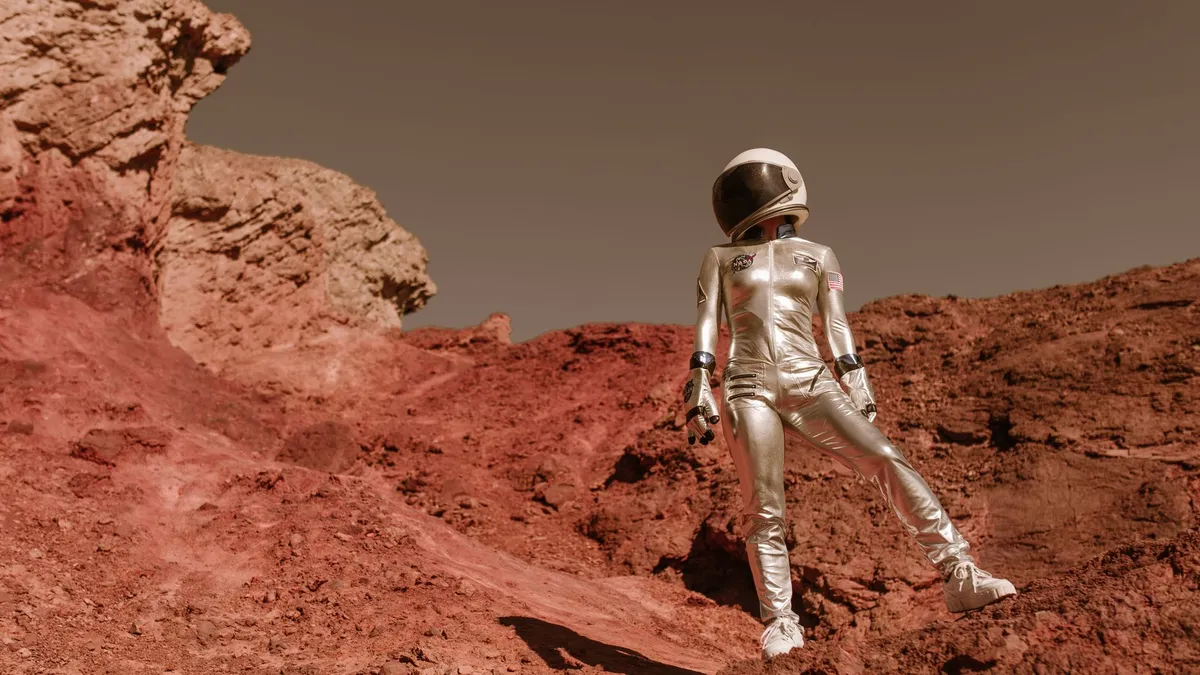
Mars surface operations will require colonists to wear EVA suits weighing roughly 130 kg on Earth but only about 50 kg on Mars. Obstacle course events in pressurized suits — navigating terrain, moving equipment, scaling rock faces — blend training utility with competition in a uniquely Martian way. This is sport as survival rehearsal.
The Social Function of Martian Sport
Beyond fitness, the first sports league on Mars will matter enormously for psychological cohesion. NASA's Human Research Program identifies behavioral health and performance as one of the primary risks for long-duration spaceflight and surface operations. Structured play, team identity, and the ritual of competition are proven tools for maintaining morale in isolated, confined environments — from Antarctic research stations to submarine crews.
The colonists who invent the first Martian games won't just be athletes. They'll be cultural architects, building shared meaning in a place where every tradition has to be created rather than inherited.
Whatever those games look like, they'll be something no human has ever played before — born from necessity, shaped by physics, and watched by people who traveled 225 million kilometers to get a front-row seat.
Frequently Asked Questions
What sports would Martians play?
Low gravity would favor entirely new games emphasizing spectacular jumps, flight, and three-dimensional movement, along with heavily modified versions of Earth sports rebalanced for 38% gravity and enclosed habitats.
Why can't Earth sports be played unchanged on Mars?
At 38% of Earth's gravity, balls fly farther, jumps go higher, and falls are slower, so field sizes, rules, and equipment would all need rebalancing to stay competitive and safe.
Would Mars have professional sports?
Over time, likely yes — sports historically follow humans everywhere, and a Martian league would become part of the colony's culture and identity, invented around its unique physics.