Mars Is Not as Dry as It Looks
Early telescopic observers saw a rust-colored desert world, and for decades Mars seemed irredeemably parched. That picture has changed dramatically. Decades of orbital radar surveys, robotic landers, and atmospheric measurements have revealed that Mars holds a significant inventory of water — locked in ice, buried underground, and suspended in trace amounts in the air. The question for future human missions is no longer whether water exists on Mars, but how to reach it.
The Polar Ice Caps: A Known Reservoir
The most visible water on Mars sits at both poles in layered deposits of ice and dust called the Polar Layered Deposits (PLDs). The north polar cap, centered on Planum Boreum, is primarily water ice. Estimates based on orbital observations suggest it contains roughly 1.2 million cubic kilometers of water ice — enough, if melted, to cover the entire planet in a shallow ocean about 5.6 meters deep.
The south polar cap is more complex. Its permanent surface layer is carbon dioxide ice, which persists year-round. Beneath that CO₂ veneer, however, lies a substantial water ice deposit. The CO₂ cap itself is relatively thin — on the order of 8 meters in places — but the underlying water ice extends much deeper into the Promethei Lingula and surrounding terrain.
Seasonal changes are dramatic at both poles. Each Martian winter, CO₂ from the atmosphere freezes out and deposits onto the caps, adding temporary layers that sublimate away each spring. This annual cycle has been tracked by instruments including the Mars Climate Sounder aboard NASA's Mars Reconnaissance Orbiter (MRO).
What Radar Has Revealed Underground
Ground-penetrating radar has transformed our understanding of subsurface water on Mars. Two instruments in particular have done the heavy lifting.
MARSIS (Mars Advanced Radar for Subsurface and Ionosphere Sounding)
Carried by ESA's Mars Express spacecraft, MARSIS has been probing beneath the Martian surface since 2005. In 2018, a team analyzing MARSIS data published findings in the journal Science reporting a bright radar reflection approximately 1.5 kilometers beneath the south polar layered deposits. The signal's characteristics were consistent with liquid water — a subglacial lake roughly 20 kilometers across, kept liquid by geothermal heat and the freezing-point depression caused by dissolved salts. Subsequent reanalysis has generated debate about whether all such reflections indicate liquid water or might reflect other materials like clay-rich sediments, but the original interpretation remains scientifically credible and actively studied.
SHARAD (Shallow Radar)
Aboard NASA's Mars Reconnaissance Orbiter, SHARAD operates at a higher frequency than MARSIS, giving it finer vertical resolution at shallower depths — roughly the top few hundred meters. SHARAD has mapped extensive radar-bright layers within the Polar Layered Deposits and has confirmed buried ice deposits in mid-latitude regions, including the Medusae Fossae Formation. Critically, SHARAD data has revealed buried glaciers in both hemispheres at latitudes between roughly 35° and 60°, covered by thin layers of dust and debris. Some of these deposits are estimated to contain ice volumes comparable to Greenland's ice sheet.
Phoenix Lander: Direct Confirmation
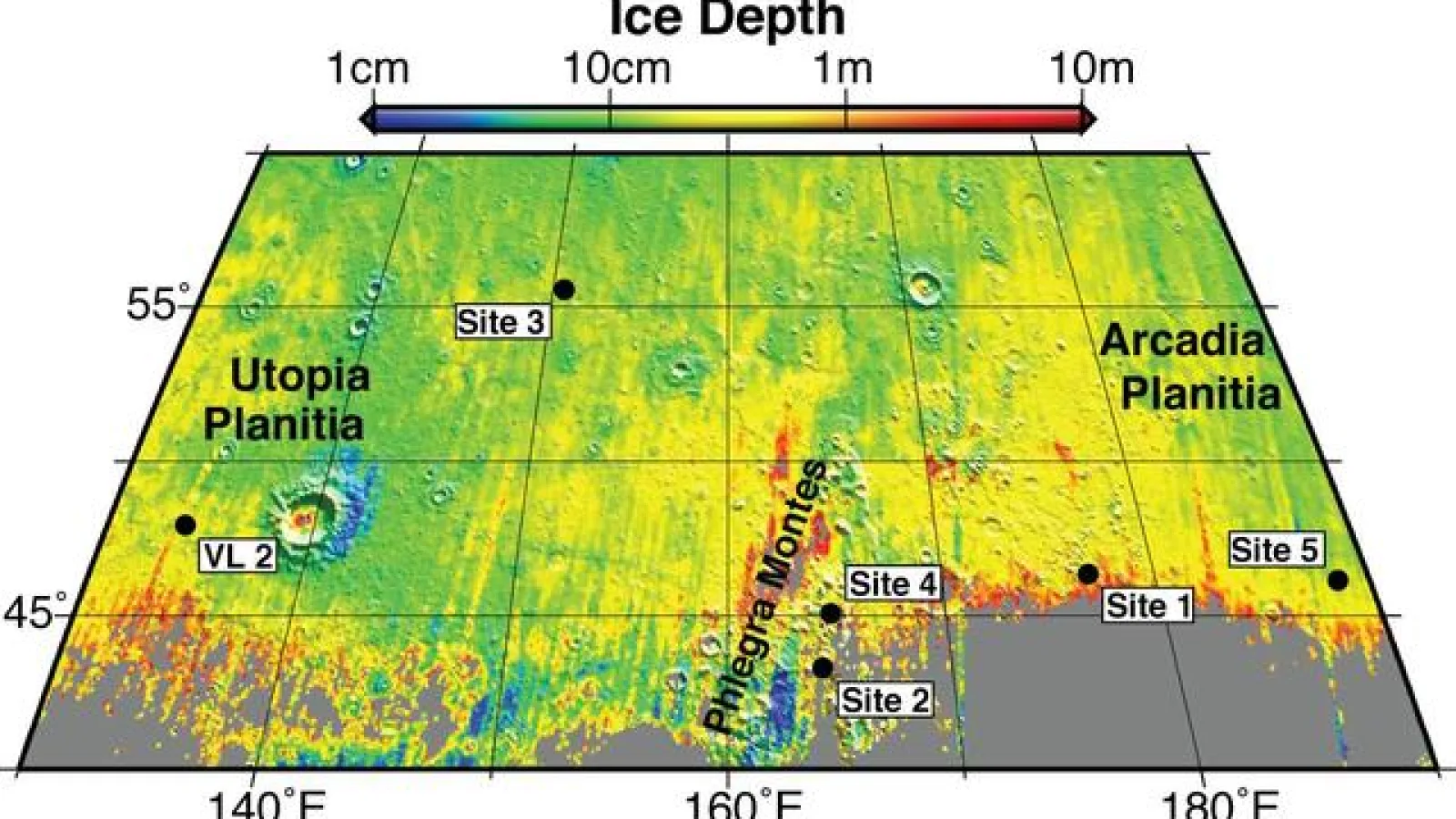
In 2008, NASA's Phoenix Mars Lander settled into the northern plains at about 68° north latitude — well above the Arctic Circle equivalent on Mars. Within days of landing, Phoenix used its robotic arm to scrape into the shallow soil and exposed bright white chunks just centimeters below the surface. Mission scientists watched those chunks disappear over subsequent sols (Martian days), sublimating directly into the thin atmosphere. The material behaved exactly as water ice would in the near-vacuum conditions of the Martian surface.
Phoenix also carried a wet chemistry laboratory called MECA (Microscopy, Electrochemistry, and Conductivity Analyzer), which confirmed that the soil contained water ice when heated. The landing site's ice table — the depth at which buried ice begins — was just 5 to 18 centimeters below the surface at that location. This direct physical confirmation gave mission planners confidence that shallow ice is widespread at high Martian latitudes.
Atmospheric Water Vapor
Mars's atmosphere is extremely thin, averaging about 600 pascals of surface pressure (less than 1% of Earth's sea level). Despite that, water vapor is present, concentrated mostly in the lower atmosphere and varying seasonally. Total atmospheric water content is small — if all of it precipitated out, it would form a layer only tens of micrometers thick across the planet — but it represents a potentially accessible resource.
How to Extract Water on Mars
Confirmed ice locations are only half the problem. Getting usable water out of frozen regolith or buried deposits requires engineering solutions suited to Mars's harsh environment.
Thermal Extraction (Heating Elements)
The most straightforward method involves drilling or excavating icy regolith and applying heat to sublimate or melt the ice. The water vapor or liquid is then captured and condensed. NASA's ISRU (In-Situ Resource Utilization) program has studied resistive heating elements embedded in drill heads or processing chambers. The energy cost is the key challenge: Mars receives about 43% of the solar energy that Earth does at equivalent latitudes, making power budgets tight.
Microwave Extraction
Microwave energy can penetrate soil and heat ice-bearing regolith in place, potentially allowing water vapor to migrate upward into a collection dome without full excavation. Research groups at several universities have prototyped microwave extraction systems for lunar and Martian regolith. This approach may be more energy-efficient than bulk excavation for deep or dispersed ice deposits.
Atmospheric Water Vapor Collection
Adsorption-based systems — using materials that chemically bind water molecules from the air during cold nighttime hours, then release them when heated during the day — have been proposed for Mars. MIT researchers and teams studying the Mars MOXIE experiment (which demonstrated oxygen production from Martian CO₂ aboard the Perseverance rover) have explored complementary water-harvesting concepts. Yields would be modest given the low atmospheric humidity, but such systems could supplement other sources for small crews.
What This Means for Human Missions
Water on Mars is real, mapped, and in some locations only centimeters underground. The Phoenix lander proved ice is accessible without deep drilling at high latitudes. SHARAD has identified mid-latitude buried glaciers that could serve as water sources for outposts outside the polar regions. Extraction technology is advancing, though no system has yet operated on Mars at human-mission scale.
The path forward involves landing near confirmed shallow ice deposits, deploying tested ISRU hardware, and producing water locally rather than hauling it from Earth. Given that every kilogram launched from Earth carries an enormous fuel cost, Martian water isn't just a scientific curiosity — it's a mission-critical resource.