Why Race on Mars?
Before the first permanent settlement is fully operational, humans on Mars will need recreation, morale boosters, and ways to test the vehicles that keep them alive. Racing checks all three boxes. It sounds like entertainment, but at its core, a Martian race is an engineering stress test wrapped in competition. Every vehicle that tears across Hellas Planitia or climbs the flanks of Olympus Mons is proving something about suspension travel, battery efficiency, and suit life-support redundancy.
The question isn't whether people on Mars will race. It's what a well-designed course would actually demand of machines and drivers.
The Martian Environment Changes Everything
Mars has roughly 38% of Earth's surface gravity and an atmospheric pressure less than 1% of sea level on Earth — about 600 to 700 pascals on average. That combination reshapes race course design from the ground up.
- Low gravity, high airtime: At 0.376 g, a vehicle hitting a modest jump at 60 km/h stays airborne far longer than on Earth. Course designers would need to account for extended flight distances and harder landings on uneven regolith.
- No aerodynamic downforce: The near-vacuum atmosphere means wings and spoilers are essentially useless. Mechanical grip — tire compound, suspension geometry, and vehicle weight distribution — becomes the only performance variable that matters.
- Thermal extremes: Surface temperatures swing from about -73°C at night to near 20°C at the equator during summer afternoons. Lubricants, batteries, and electronics must function across that range within a single race day.
- Dust: Martian dust particles average around 3 microns in diameter — fine enough to infiltrate seals and coat solar panels. Any race vehicle would require aggressive filtration and sealed drivetrain compartments.
Choosing the Course Location
Three regions stand out as realistic candidates for a Martian race circuit.
Hellas Planitia
The Hellas impact basin is the largest confirmed crater in the solar system, stretching approximately 2,300 kilometers across and sitting about 7 kilometers below the Martian mean surface level. That depth means atmospheric pressure there is slightly higher than elsewhere on Mars — a marginal but real advantage for thermal management. The basin floor is relatively flat, offering long straights interrupted by ancient lava-flow ridges that create natural chicanes.
Valles Marineris
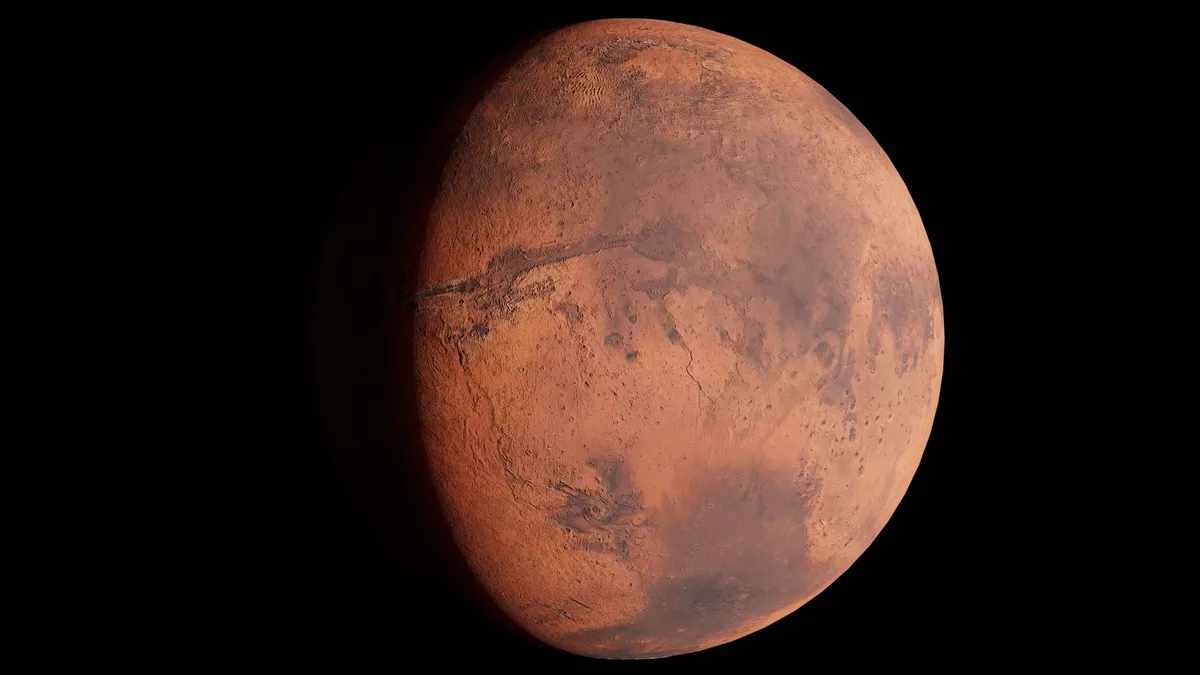
The canyon system that dwarfs Earth's Grand Canyon — stretching over 4,000 kilometers and dropping up to 7 kilometers deep — offers dramatic elevation changes and protected sections where wind speeds may be reduced by canyon walls. Technical sections through side canyons called chasmata would challenge navigation and vehicle articulation simultaneously.
Amazonis Planitia
One of the flattest surfaces in the solar system, Amazonis Planitia could host pure speed events. Radar altimetry data from NASA's Mars Global Surveyor showed elevation variations of less than 100 meters across hundreds of kilometers. Think salt flats, but colder and with a pink sky.
Vehicle Design Requirements
A purpose-built Martian racer would share more DNA with lunar rovers and pressurized exploration vehicles than with anything currently racing on Earth. Key requirements include:
- Electric drivetrain — combustion is impossible without a usable oxygen atmosphere
- Pressurized or fully sealed cockpit rated to at least 34 kPa, the minimum pressure for consciousness without a pressure suit
- Independent suspension with at least 500mm of travel per wheel to absorb basalt rock fields
- Redundant battery systems — solar charging is slower on Mars, which receives about 43% of the solar energy Earth does at the same distance from the sun
- Radiation shielding in the cockpit, since Mars lacks a global magnetic field
The Practical Case for Martian Racing
Settlement planners from NASA's Moon to Mars Architecture and concepts developed by groups like the Mars Society have consistently emphasized that early colonists will require structured recreation to maintain psychological health during multi-year surface stays. Racing on Mars isn't a frivolous fantasy. It's a high-performance proving ground dressed up as sport — and that combination has worked on Earth for over a century.
The red planet has the terrain. It just needs the engineers brave enough to design for it.
Frequently Asked Questions
Would motor racing work on Mars?
In principle, but it would be radically different. Low gravity reduces traction, the thin atmosphere changes aerodynamics and cooling, and vehicles would need pressurized, radiation-shielded cockpits and dust-tolerant designs.
What makes a Mars race course challenging?
Dramatic terrain like craters, canyons, and dunes, plus low gravity that lengthens jumps and reduces grip, and a thin atmosphere that alters braking and handling — all demanding new vehicle and course design.
Would Mars vehicles look like Earth race cars?
No. They'd need sealed cockpits with life support, radiation shielding, dust-proofing, and traction and aerodynamic solutions suited to low gravity and a near-vacuum atmosphere.