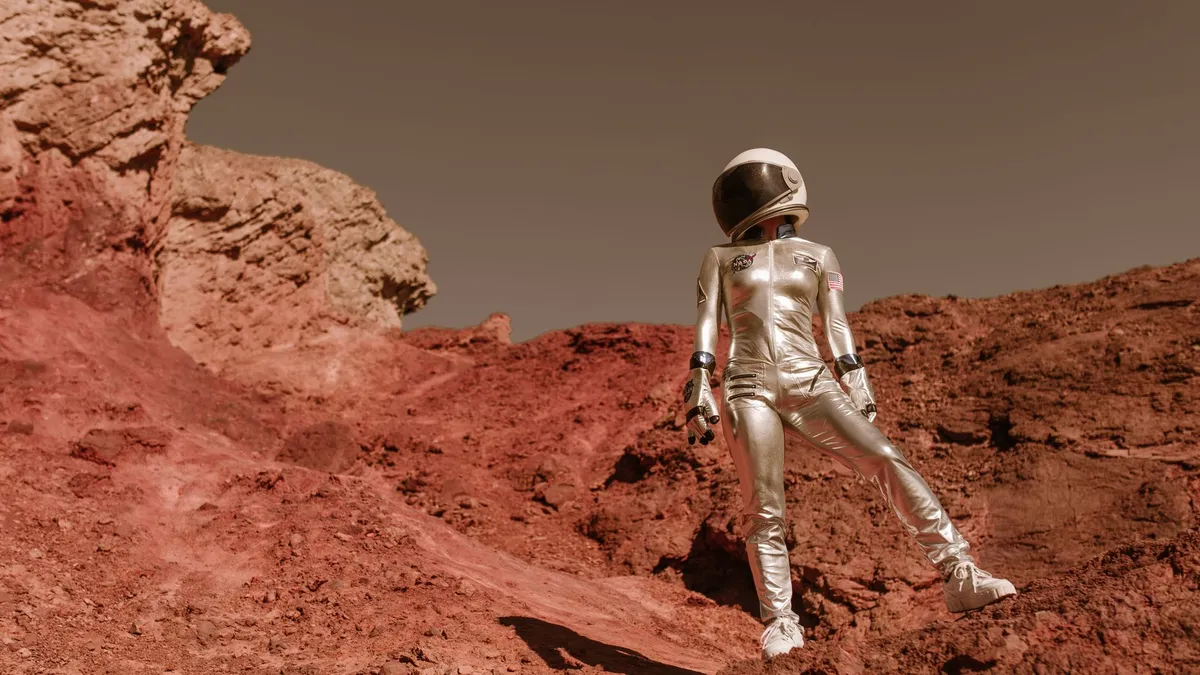
Dressing for a Planet That Wants to Kill You
Mars has an average surface temperature of around -60°C (-76°F), an atmospheric pressure less than 1% of Earth's at sea level, and no magnetic field to block solar and cosmic radiation. Before colonists worry about what looks good, they need to think about what keeps them alive. The clothing challenge on Mars is less about fashion and more about engineering — but the two aren't entirely separate.
The Pressure Suit: First Line of Defense
Any time a Mars colonist steps outside a pressurized habitat, they'll need a surface suit capable of maintaining breathable pressure around their body. NASA's current work on next-generation suits — including the xEMU (Exploration Extravehicular Mobility Unit) developed for Artemis lunar missions — offers a preview of where Mars suit technology is heading.
Mars suits will need to solve a unique set of problems compared to lunar or ISS suits. The Martian surface presents fine, potentially toxic perchlorate-laden dust that can cling to almost any material. Suit joints need enough flexibility for colonists to work, dig, and build — possibly for hours at a time — without causing the muscle fatigue that current bulky suits impose. NASA engineers have described current EVA suits as "wearing a pressurized balloon," and Mars work demands something significantly more agile.
MIT's BioSuit project, led by researcher Dava Newman, has explored a counter-pressure approach: instead of surrounding the body in pressurized gas, a tight-fitting mechanical suit applies pressure directly to the skin. This could allow far greater mobility. A functional Mars suit might weigh around 30 kg (66 lbs) in Earth gravity — far lighter than the roughly 130 kg Apollo suits — because Mars gravity is only about 38% of Earth's.
Inside the Habitat: Everyday Wear
Inside pressurized habitats or vehicles, colonists won't need pressure suits. But the indoor environment will still shape what they wear. Habitat interiors will likely be maintained at near-Earth pressure and temperature, but humidity control, electrostatic dust management, and limited resupply will all influence clothing choices.
Expect everyday Mars clothes to prioritize:
- Durability: With resupply missions taking six to nine months and launching only during favorable launch windows every 26 months, clothing will need to last. Merino wool, technical synthetics like Polartec, and graphene-enhanced textiles are all candidates for long-wear fabrics.
- Thermal regulation: Even indoors, temperature management matters. Mars habitats will likely run cooler than typical Earth offices to reduce energy load.
- Radiation monitoring: Colonists may wear dosimetry devices integrated into their clothing — essentially smart textiles that track cumulative radiation exposure.
- Antimicrobial properties: In a closed environment, keeping microbes in check is a genuine health priority. Silver-threaded and copper-embedded fabrics, already used in some medical and athletic applications, could become standard.
The Thermal Underlayer Problem
EVA suits need underlayers — garments worn between bare skin and the suit itself. On the ISS, astronauts wear a Liquid Cooling and Ventilation Garment (LCVG), a mesh of thin tubes that circulates water to manage body heat during spacewalks. Mars suits will likely include a similar system, possibly improved with phase-change materials that absorb and release heat more efficiently than water alone.
Color, Culture, and Identity
Here's where practical engineering meets something more human. Early colonists will have almost no say in what they wear — it'll be dictated entirely by safety requirements and what fits in a cargo manifest. But as communities grow and manufacturing develops on Mars, a local textile culture will almost certainly emerge.
Mars colonists will be pioneers building a civilization from scratch, and throughout human history, clothing has been one of the first ways communities assert identity. Whether that means brightly colored habitat suits, locally 3D-printed accessories, or recycled fabric art, the social dimension of Mars fashion is a genuine part of the colonization story — just one that comes after the engineering problems are solved.
The Bottom Line
Mars colonist clothing will be driven by survival first: pressure, temperature, radiation, and durability. But the trajectory points toward increasing sophistication. NASA, MIT, and private companies like SpaceX are all developing technologies that will inform what the first Martians wear. The spandex jumpsuit of science fiction might be closer to reality than you'd expect — just with a whole lot of engineering underneath.
Frequently Asked Questions
What would Mars colonists wear?
Indoors, comfortable clothing suited to a climate-controlled habitat, likely made from recycled and locally producible materials. Outside, everyone needs a pressurized suit with life support and radiation protection.
Why can't colonists wear normal clothes outside on Mars?
Mars's atmosphere is less than 1% as dense as Earth's and offers no breathable air or radiation shielding, so any outdoor activity requires a pressurized, protective suit rather than ordinary clothing.
Would Mars develop its own fashion?
Likely yes — shaped by local materials, recycling constraints, and cultural identity, Martian fashion would evolve its own distinct look rather than simply importing Earth trends.