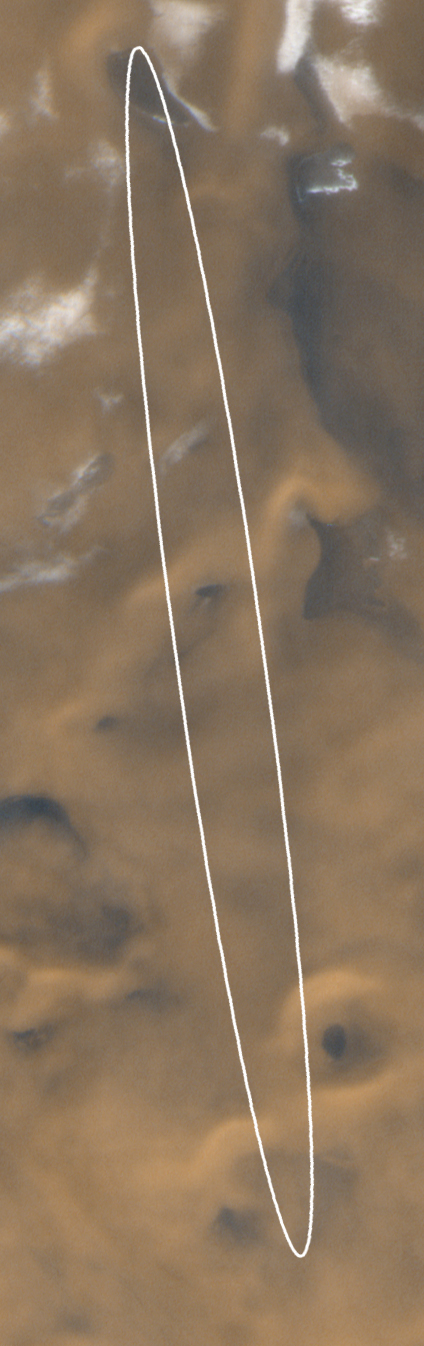
In late 1999, NASA's Mars Polar Lander was making its final approach toward the Red Planet, targeting a carefully selected landing zone near the Martian south pole. The target ellipse — a defined area within which the spacecraft was expected to touch down — represented the culmination of months of planning, orbital mechanics calculations, and surface analysis by mission scientists. This ellipse was located at approximately 76 degrees south latitude, placing it tantalizingly close to the edge of Mars's southern polar layered deposits, one of the most scientifically compelling regions on the entire planet.
The southern polar region of Mars holds extraordinary scientific value. Beneath its seasonal coating of carbon dioxide frost lies a permanent ice cap composed of both water ice and CO2 ice, layered over millennia like pages in a geological diary. Scientists believed that drilling or scraping into these layers could reveal a record of Martian climate cycles stretching back millions of years, offering clues about how the planet's axial tilt and orbital variations have driven dramatic shifts in its atmosphere and surface conditions over time.
Mars Polar Lander carried a suite of instruments designed specifically to interrogate this frozen environment. Its robotic arm was equipped to dig into the surface soil and deliver samples to the Thermal and Evolved Gas Analyzer, which would heat the material and sniff for water vapor and other volatiles. The lander also carried microphones intended to record Martian wind — what would have been the first direct acoustic recording of another planet's atmosphere — and a pair of small surface penetrators called Deep Space 2, designed to punch into the soil and measure subsurface temperature and moisture.
Tragically, Mars Polar Lander fell silent on December 3, 1999, during its entry, descent, and landing sequence, and was never heard from again. A subsequent investigation suggested that spurious signals from leg deployment sensors may have caused the engines to shut down prematurely, sending the spacecraft crashing into the Martian surface. Despite the mission's failure, the science questions it sought to answer remained urgent, later inspiring missions like Phoenix in 2008, which successfully landed in Mars's northern polar region and confirmed the presence of water ice just beneath the surface.