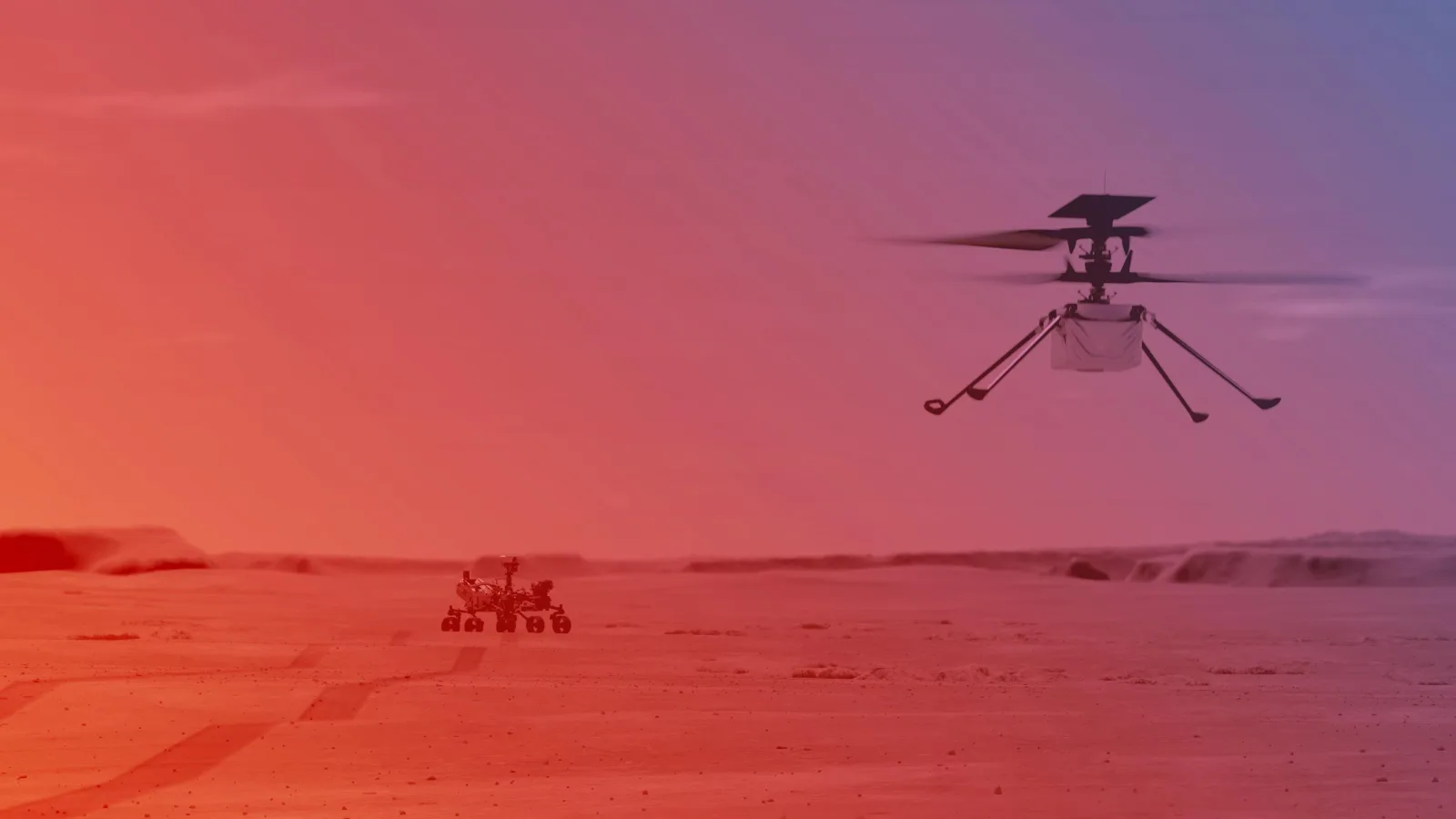
On the morning of April 19, 2021, a carbon-fiber helicopter weighing just 1.8 kilograms lifted off from the floor of Jezero Crater, climbed to three meters, hovered for 39 seconds, and touched back down. It was the first powered, controlled flight ever performed on another world — an aeronautical milestone as fundamental to Mars as the Wright brothers' 12-second hop at Kitty Hawk was to Earth. Fittingly, tucked beneath Ingenuity's solar panel was a small swatch of fabric from that original 1903 Flyer.
Why Flying on Mars Is So Hard
The physics that make Ingenuity remarkable are the same ones that made most engineers doubt it could work at all. The Martian atmosphere is barely there — roughly one percent the density of Earth's at sea level. Lift depends on pushing against air, and on Mars there is almost nothing to push against. A rotor that would hold a craft aloft on Earth would find only near-vacuum on Mars.
The engineering answer was to spin the blades far faster than any terrestrial helicopter and to make the entire machine extraordinarily light. Ingenuity's twin counter-rotating rotors turned at well over 2,000 revolutions per minute — several times the speed of a conventional helicopter — while the airframe was pared down to the mass of a bag of sugar. Every gram mattered. The blades themselves had to be rigid, precisely shaped, and tuned to bite into thin carbon-dioxide air rather than the nitrogen-oxygen mix they would have been designed for on Earth.
There was also the problem of control. The radio delay between Earth and Mars can run from several minutes to more than twenty, far too long for a human pilot to react to a wobble. Ingenuity had to fly itself, using onboard sensors and a downward-looking camera to hold position and correct for gusts entirely on its own.
From Technology Demo to Aerial Scout
Ingenuity was never meant to last. NASA planned five demonstration flights over thirty days — enough to prove the concept and retire the risk for future designs. Instead, the little helicopter kept flying, month after month, far beyond its original mandate. It logged dozens of flights and covered kilometers of ground, transforming from a one-off experiment into a working reconnaissance partner for the Perseverance rover.
That scouting role turned out to be its most valuable legacy. Flying ahead of the rover, Ingenuity photographed terrain from angles no ground vehicle could reach, flagged obstacles, and helped mission planners choose safe, science-rich driving routes. It proved that an aerial scout is not a luxury on Mars but a genuine force multiplier — a way to see over the next ridge before committing a billion-dollar rover to the path.
What Ingenuity Made Possible
Every future Mars aircraft now stands on Ingenuity's shoulders. Its success has moved concepts for larger, instrument-carrying rotorcraft from wishful sketches to funded engineering studies. The demonstration that controlled flight is achievable in the Martian atmosphere reshaped how mission designers think about exploring the vast distances and impassable terrain that have always limited wheeled rovers. The same thin-air problem that nearly killed the idea is now a solved problem, and the machines that follow will carry science instruments where wheels can never go.
Ingenuity also demonstrated something harder to quantify: that Mars exploration can still deliver genuine firsts. The oxygen-making experiment that flew on the same mission, MOXIE, proved a colonist could someday breathe Martian air. Ingenuity proved a colonist could someday fly through it.
Frequently Asked Questions
When did Ingenuity fly on Mars?
Ingenuity made its first flight on April 19, 2021, hovering for about 39 seconds at three meters altitude in Jezero Crater — the first powered, controlled flight on another planet.
Why is it hard to fly a helicopter on Mars?
The Martian atmosphere is roughly one percent as dense as Earth's at sea level, so rotors have almost no air to push against. Ingenuity compensated by spinning its blades several times faster than an Earth helicopter and by being extremely lightweight, at about 1.8 kilograms.
How many flights did Ingenuity complete?
Ingenuity was designed for just five demonstration flights over thirty days but went on to complete dozens of flights over several years, serving as an aerial scout for the Perseverance rover.