The Most Important Decision in Mars Exploration
Before a Mars mission turns a single wheel or drills a single core, engineers and scientists must agree on four precise numbers: a latitude, a longitude, an elevation, and a landing ellipse. That decision can determine whether a mission succeeds or fails, whether a crew stays warm or freezes, and whether explorers find scientifically valuable terrain or barren rock. Choosing a landing site on Mars is one of the most contested, data-intensive processes in planetary science.
NASA typically opens candidate sites to the broader scientific community through a series of open workshops. The Mars 2020 landing site selection process, for example, ran for more than four years and included over 1,000 scientists evaluating more than 60 candidate locations before Jezero Crater was selected in November 2018. For human missions, the stakes — and the constraints — are considerably higher.
The Five Competing Factors
1. Elevation and Atmospheric Pressure
Mars's atmosphere is already thin — roughly 0.6% of Earth's sea-level pressure on average — but elevation makes an enormous difference. Higher altitudes mean even lower air pressure, which shortens the time available for parachutes and retrorockets to slow a descending spacecraft or lander. NASA's entry, descent, and landing (EDL) systems require a minimum atmospheric column to function safely.
This is why Hellas Planitia, the largest confirmed impact crater in the solar system at approximately 7 kilometers below the Martian datum (the planet's average surface level), is attractive from an engineering standpoint. The thicker air at its floor gives landers more room to decelerate. For crewed missions, this same pressure advantage matters for habitat design and EVA suit engineering.
2. Latitude, Solar Power, and Temperature
Latitude shapes nearly every aspect of surface operations. Sites closer to the equator receive more consistent solar energy year-round, which is critical for solar-powered rovers and early crewed outposts that haven't yet established nuclear power. Equatorial regions also experience less extreme temperature swings, with daytime highs near the equator sometimes reaching -20°C compared to -125°C near the poles in winter.
However, equatorial sites are often geologically older and may offer less access to near-surface water ice — a resource critical for long-duration human missions. This creates a direct tension between power availability and resource access.
3. Proximity to Water Ice
For human missions, water ice is arguably the single most valuable resource on Mars. It can be converted into drinking water, oxygen for breathing, and hydrogen for rocket propellant through in-situ resource utilization (ISRU). Radar data from the SHARAD instrument aboard NASA's Mars Reconnaissance Orbiter and the MARSIS radar on ESA's Mars Express have mapped extensive subsurface ice deposits, with some of the most accessible concentrations found at mid-to-high latitudes.
Arcadia Planitia, a broad volcanic plain in the northern hemisphere at roughly 40–50°N latitude, has emerged as a leading candidate for human missions partly because radar data suggest ice lies within just one to two meters of the surface in some areas — shallow enough that future excavation equipment could reach it.
4. Geological and Scientific Interest
Robotic missions are primarily science-driven, so geological context is paramount. Sites with evidence of ancient water activity, hydrothermal systems, or organic chemistry preservation are prioritized. Jezero Crater, selected for the Perseverance rover, offered a compelling case: orbital imagery and spectroscopy revealed it once held a lake fed by river deltas, with carbonate and olivine minerals that could preserve biosignatures from Mars's wetter past approximately 3.5 billion years ago.
5. Terrain Safety
A scientifically perfect site is useless if a lander tips over or a rover gets stuck. Engineers evaluate slope angles (typically requiring less than 15 degrees for safe landing), rock density (large boulders can damage landing systems), and the presence of hazardous features like sand dunes or cliff edges. Perseverance's landing ellipse in Jezero was approximately 7.7 by 6.6 kilometers — the smallest ever targeted for a Mars rover at the time — made possible by the Terrain-Relative Navigation system that allowed the spacecraft to autonomously avoid hazards during descent.
Three Sites Worth Knowing
Hellas Planitia
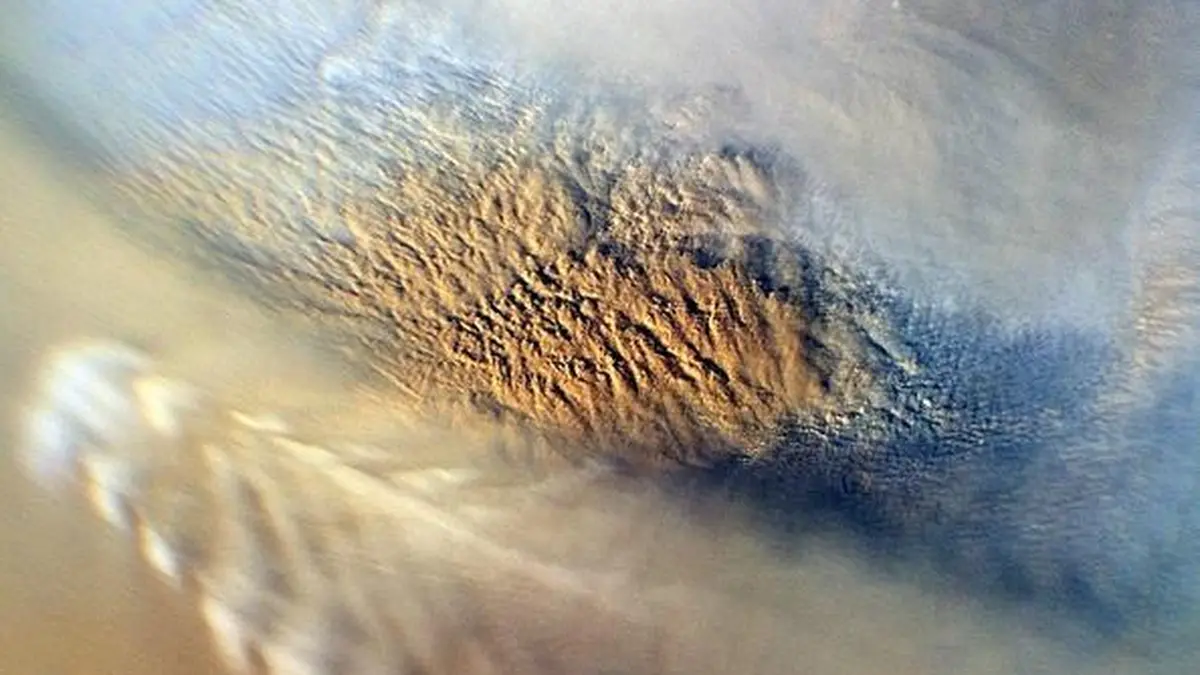
At 2,300 kilometers wide and up to 7 kilometers deep, Hellas Planitia offers the thickest accessible atmosphere on Mars. Surface pressure here can reach 1,155 pascals — nearly double the planetary average. This makes it valuable for EDL engineering studies and potentially for early crewed missions. However, it sits far from confirmed near-surface ice deposits, and dust storms tend to pool in the basin.
Jezero Crater (18.4°N, 77.7°E)
Now home to the Perseverance rover since February 2021, Jezero is the current gold standard for Mars science. Its ancient river delta and lakebed sediments make it one of the most promising locations to search for preserved signs of ancient microbial life. Perseverance has already collected dozens of sealed sample tubes intended for eventual return to Earth as part of the Mars Sample Return campaign.
Arcadia Planitia
Consistently ranked among the top sites for human missions, Arcadia Planitia combines relatively accessible latitude, evidence of shallow ground ice from SHARAD radar data, and generally smooth terrain. A 2020 study published in Nature Astronomy by Bramson and colleagues specifically highlighted Arcadia as containing thick, nearly pure water ice deposits that formed from snowfall during past periods of higher Martian obliquity.
How NASA Makes the Final Call
Landing site selection is never a single decision made in a single room. It is a years-long process combining orbital remote sensing, atmospheric modeling, EDL simulation, and community science input. For robotic missions, the goal is maximizing scientific return within engineering constraints. For future human missions, life support, resource availability, and crew safety push to the front of the list.
What both processes share is the same fundamental challenge: Mars is a world of trade-offs, and there is no perfect landing site. Every location demands compromise. The goal is finding the spot where the compromises are ones humanity can live with — and, eventually, simply live.