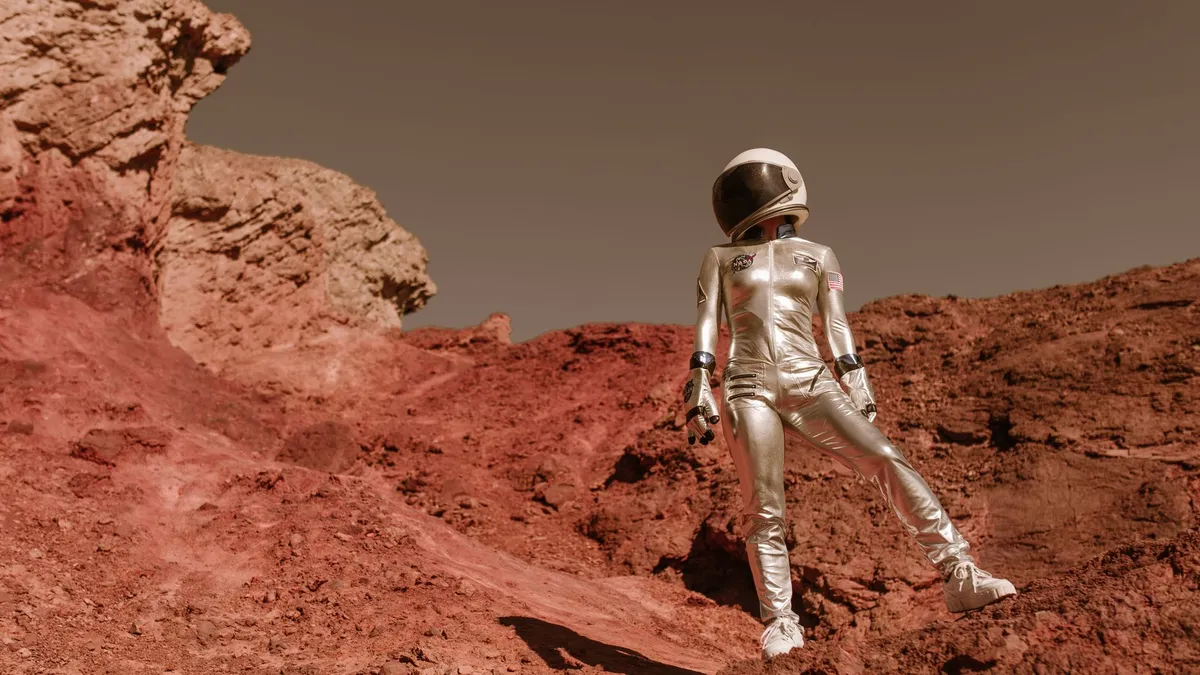
The Radiation Problem on Mars
Mars does not have a global magnetic field, and its atmosphere is roughly 100 times thinner than Earth's. That combination means the Martian surface offers almost no natural protection against space radiation. Data from NASA's Curiosity rover, measured by its Radiation Assessment Detector (RAD) instrument, puts the average surface dose at approximately 0.67 millisieverts (mSv) per day — around 240 mSv per year.
For context, the average American receives about 6.2 mSv per year from all sources combined. NASA's current career exposure limit for astronauts is 600 mSv lifetime — a threshold a Mars colonist could approach within just three years of surface exposure without any shielding at all. During solar particle events (SPEs), that daily dose can spike dramatically higher, potentially reaching dangerous acute levels within hours.
Two types of radiation dominate the Martian surface environment: galactic cosmic rays (GCRs), which are high-energy particles streaming in from outside the solar system, and solar energetic particles (SEPs), which are bursts of protons and electrons ejected by the Sun. Each presents different shielding challenges, and any EVA suit designed for Mars must contend with both.
Why Suit Shielding Is Harder Than It Sounds
Shielding against radiation sounds straightforward — put enough material between the astronaut and the source. But the physics of high-energy cosmic rays makes this genuinely complicated. When GCRs slam into dense materials like lead or iron, they trigger secondary particle showers — cascades of neutrons and lighter particles that can actually increase the radiation dose inside the shielding. This is known as secondary radiation production, and it makes heavy metals a poor choice for deep-space and planetary surface suits.
The most effective shielding materials for GCRs are hydrogen-rich compounds, because hydrogen atoms are close in mass to incoming protons and absorb energy more efficiently without producing dangerous secondaries. That insight drives most of the serious research into Mars EVA suit materials.
The Leading Shielding Materials
High-Density Polyethylene (HDPE)
High-density polyethylene is currently the leading candidate for radiation shielding in both spacecraft and suits. It's hydrogen-rich, relatively lightweight, and can be manufactured into flexible forms. NASA has already incorporated HDPE panels into crew quarters aboard the International Space Station as storm shelter protection. For a Mars suit, HDPE layers woven into or laminated onto the suit structure could provide meaningful GCR attenuation without the secondary particle problem that plagues metals. The trade-off is bulk — enough HDPE to make a significant difference adds weight and can restrict movement.
Water
Water is extraordinarily effective at stopping radiation. It's dense, hydrogen-rich, and produces minimal secondary particles. Some suit concepts propose a water-layer bladder integrated into the suit structure — essentially a thin shell of circulating or static water surrounding the torso. This approach has dual appeal: water already needs to be managed in life support systems, so a shielding-integrated water layer could serve multiple functions. The engineering challenge is keeping that water from freezing on the Martian surface, where temperatures regularly drop to -60°C or lower.
Lead and Metals
Lead remains effective against lower-energy gamma radiation and X-rays, but its secondary particle production makes it counterproductive against the high-energy GCRs that dominate outside a planetary magnetosphere. Thin metallic layers may still appear in Mars suit designs for targeted protection — around electronics, for instance — but lead-heavy suits are not a viable primary strategy.
NASA's xEMU Suit and Mars Adaptations
NASA's Exploration Extravehicular Mobility Unit (xEMU) is the agency's next-generation EVA suit, developed to replace the suits used on the International Space Station and to eventually support lunar and Mars operations. The xEMU was designed with improved mobility — notably a waist bearing and hip joints that allow astronauts to bend, kneel, and walk more naturally than was possible in Apollo-era suits.
For Mars surface operations, the xEMU architecture would require significant modifications. The Martian day (a sol) lasts 24 hours and 37 minutes, and colonists would likely conduct EVAs of 4–8 hours regularly. That extended surface time, multiplied across years of habitation, demands integrated shielding rather than a reliance on habitat shelter alone.
Current thinking from NASA and affiliated researchers points toward a layered suit architecture: an innermost thermal and pressure garment, followed by hydrogen-rich polymer shielding (likely HDPE-based composites), a micrometeorite protection layer, and an outer thermal control layer. No Mars-specific EVA suit has been finalized, but the xEMU serves as the developmental baseline.
The Mobility Trade-Off
Every kilogram of shielding added to a suit is a kilogram the astronaut must carry and move. Mars's surface gravity is 0.38g — about 38% of Earth's — which helps, but suit mass still affects fatigue, dexterity, and fall recovery. Researchers generally acknowledge that no EVA suit will fully shield a Mars colonist from GCRs. The realistic goal is dose reduction, not elimination, combined with mission planning that limits surface exposure time, prioritizes underground or bermed habitats, and uses real-time radiation monitoring to pull crews inside during solar particle events.
What This Means for Long-Term Colonization
A functional Mars EVA suit will likely reduce surface radiation exposure by 20–40%, according to modeling studies, depending on shielding thickness and design. That's meaningful but not transformative. The deeper answer to radiation protection on Mars isn't a suit — it's architecture: habitats built under meters of regolith, intelligent EVA scheduling, and biological research into radiation countermeasures. The suit is the last line of defense, not the first.