What Low Gravity Actually Means for a Leap of Faith
Mars has a surface gravity of 3.72 meters per second squared — roughly 38% of Earth's 9.81 m/s². That single number rewrites the physics of every jump, fall, and glide a human body could attempt on the Martian surface. If you stepped off a ledge on Mars, you'd fall at less than half the rate you would on Earth. A 10-meter drop that takes about 1.4 seconds on Earth would take roughly 2.3 seconds on Mars. It sounds modest, but the cascading effects on extreme sports are profound.
The Olympus Mons Scenario
Olympus Mons is the largest volcano in the solar system — roughly 22 kilometers tall and nearly 600 kilometers wide. Its northwestern escarpment drops approximately 8 kilometers in some sections, creating a cliff face with no real analogue on Earth. For context, the tallest cliff on Earth used for base jumping is the Troll Wall in Norway at around 1,100 meters. An Olympus Mons escarpment jump would be roughly seven times higher.
In Martian gravity, a jumper leaving that escarpment in free fall would take over two minutes to reach the base — assuming perfectly vertical fall, which aerodynamics would prevent. Terminal velocity on Mars is also dramatically lower due to the thin atmosphere (about 0.6% of Earth's sea-level pressure). A human in a pressure suit would likely reach terminal velocity somewhere between 40 and 70 meters per second in Mars's CO₂ atmosphere, compared to roughly 55 m/s for an unprotected skydiver on Earth. The numbers are surprisingly close in terminal velocity, but the fall itself lasts far longer and covers far more horizontal distance.
Valles Marineris: A Canyon System That Beggars Belief
Valles Marineris stretches roughly 4,000 kilometers across the Martian surface — comparable to the width of the continental United States — and plunges up to 7 kilometers deep in places. Its canyon walls would represent the most spectacular wingsuit terrain in the solar system, if a wingsuit could be engineered to function in near-vacuum pressure conditions.
This is where the atmosphere becomes the limiting factor. Standard wingsuits generate lift through air pressure differential. In Mars's thin atmosphere, you'd need a dramatically enlarged suit surface or an entirely different aerodynamic design to generate meaningful glide. Researchers at institutions including Delft University of Technology have studied low-density aerodynamics for Mars aircraft, and the consensus is that control surfaces need to be far larger than their Earth equivalents to produce comparable lift at Martian atmospheric densities.
The Suit Problem
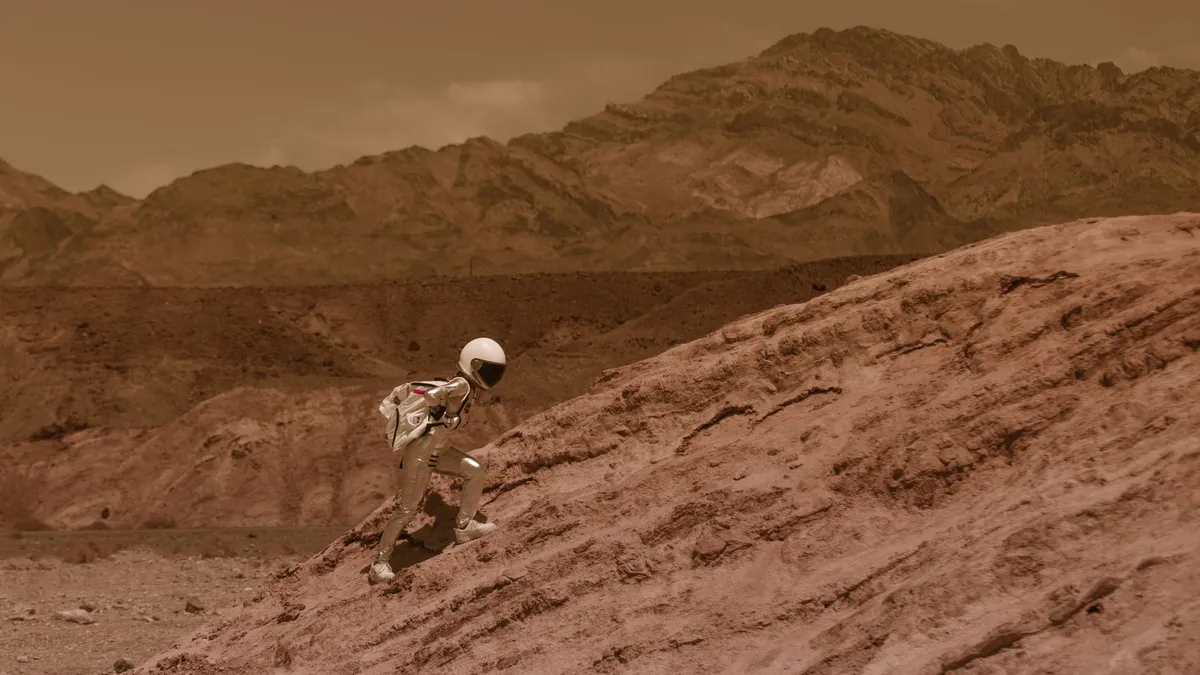
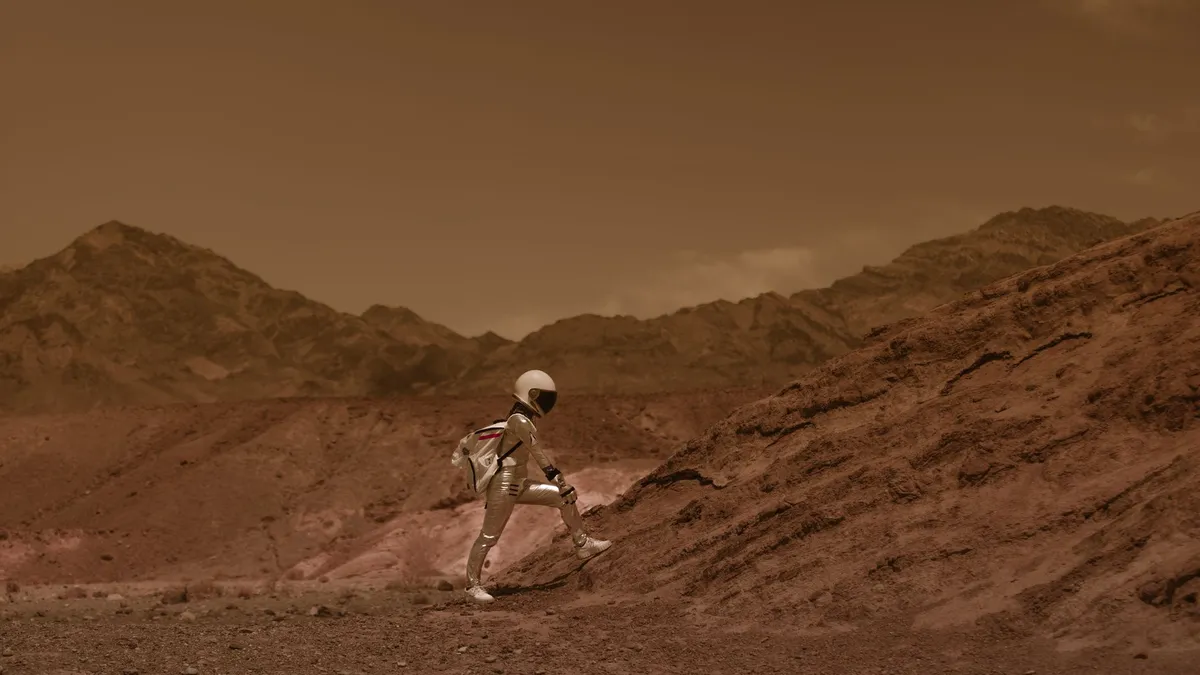
Before anyone contemplates the aerodynamics, there's a more fundamental issue: a Mars EVA suit is not a wingsuit. Current NASA exploration suit designs, including the xEMU (Exploration Extravehicular Mobility Unit) developed for lunar and eventually Mars surface operations, prioritize mobility and life support over aerodynamic performance. These suits are pressurized, bulky, and designed for walking on regolith — not falling through 0.6% atmospheric pressure at terminal velocity.
Any serious concept for Martian extreme sports would require purpose-built pressure garments that integrate aerodynamic surfaces without compromising life support. That's not science fiction — it's an engineering challenge, and one that future Mars inhabitants would have decades to solve.
Low Gravity, High Consequence
One underappreciated factor is landing. Lower gravity means lower terminal velocity in a given atmosphere, but it doesn't eliminate impact energy. A jumper hitting the Martian surface at 50 m/s arrives with significant kinetic energy regardless of what pulled them there. Parachutes work on Mars — NASA's Perseverance rover used a 21.5-meter-diameter supersonic parachute to slow from roughly 470 m/s during entry in February 2021 — but they require much larger canopies than Earth equivalents to generate equivalent drag.
A Sport Waiting for Its Athletes
None of this is imminent. The first crewed Mars missions are still years away, and survival will rightly dominate the agenda long before recreation does. But the physics are real, the terrain is extraordinary, and the mathematics of Martian gravity already suggest that whoever eventually stands at the rim of Valles Marineris and looks down will be thinking about what it would feel like to jump. The answer, at least on paper, is unlike anything possible on Earth.
Frequently Asked Questions
Could you base jump on Mars?
In principle. Mars's gravity is about 38% of Earth's, so falls last far longer, and cliffs like the Olympus Mons escarpment dwarf anything on Earth. The obstacle is the thin atmosphere and the need for a purpose-built pressure suit rather than a standard wingsuit.
Do parachutes work on Mars?
Yes, but they need much larger canopies. The thin Martian atmosphere provides little drag, which is why Perseverance used a 21.5-meter supersonic parachute during its 2021 landing to slow down.
Would wingsuit flying work on Mars?
Only with radically enlarged designs. Standard wingsuits rely on air pressure to generate lift, and Mars's atmosphere is less than 1% as dense as Earth's, so control surfaces would need to be far larger to produce meaningful glide.